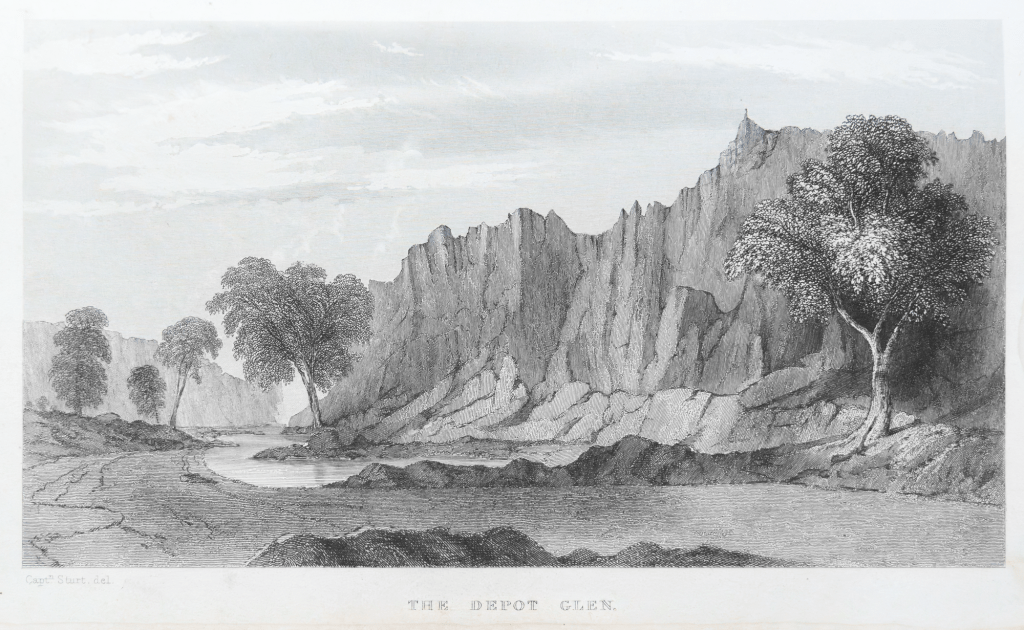
In 1844 Charles Sturt spent a couple of years looking for the inland sea. In 1827, a former East India Company officer Thomas J. Maslen, published this map of the inland sea in his book The Friend of Australia, which provided instructions for surveying and exploring the island-continent’s interior. It was a popular colonial belief that a continent the size of Australia must hold a major river system, vast mountain ranges and even an inland sea, just as the other continents did.
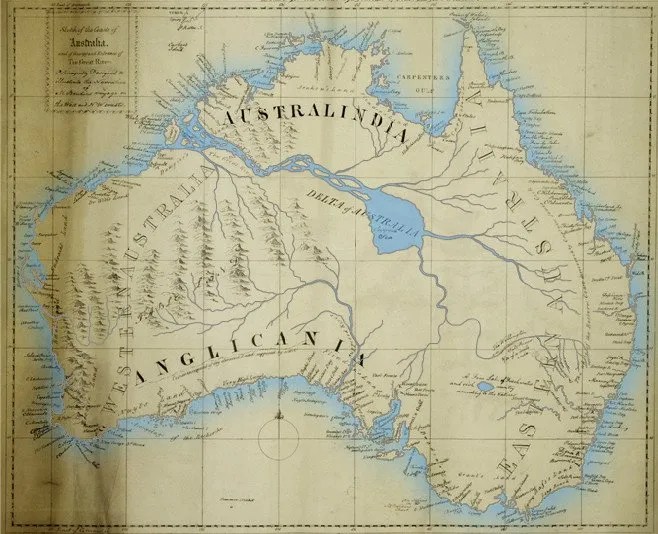
Maslen extrapolated the Macquarie and Castlereagh Rivers as headwaters of a huge river flowing across Australia into the Indian Ocean at Australia’s north-west coast. This river separated a northern land-mass (labelled ‘Australindia’) from a southern one (named ‘Anglicana’).
. Instead of an Australian Caspian fed by majestic rivers and surrounded by an Eden of fertile, lush, productive pasture Australia’s interior had become extremely hot, dry, waterless and deadly. In the mid-nineteenth century it was known as the ‘Dead Heart of Australia’ . The inland sea is a colonial myth, but an inland salt water lake is the stand in for the inland sea. This inland salt lake is the water in Lake Eyre from the floods in northern Queensland.
Sturt’s 1844 expedition was his third and final expedition, Though he had a sense of the vast drainage system into the central interior — ie., the Eyre Basin– he never got there on the 1844 expedition.
A rough account of Sturt’s 1844 expedition is that he went along the Murray River from Adelaide, then up the Darling River, went past modern day Broken Hill, came across the Lake Blanche salt lake, veered north east, crossed the Sturt Stoney Desert, Cameron Corner, then past modern Innamincka, explored the Channel Country (Cooper Creek), then went past Lake Etamunbanie and got as far north as near modern Birdsville.
Sturt could find no way through the dunes of the Simpson Desert. He turned back. Sturt’s north east journey from Adelaide had skirted around the eastern side of the Lake Eyre Basin.
 The Long Road to the North
Leave a comment