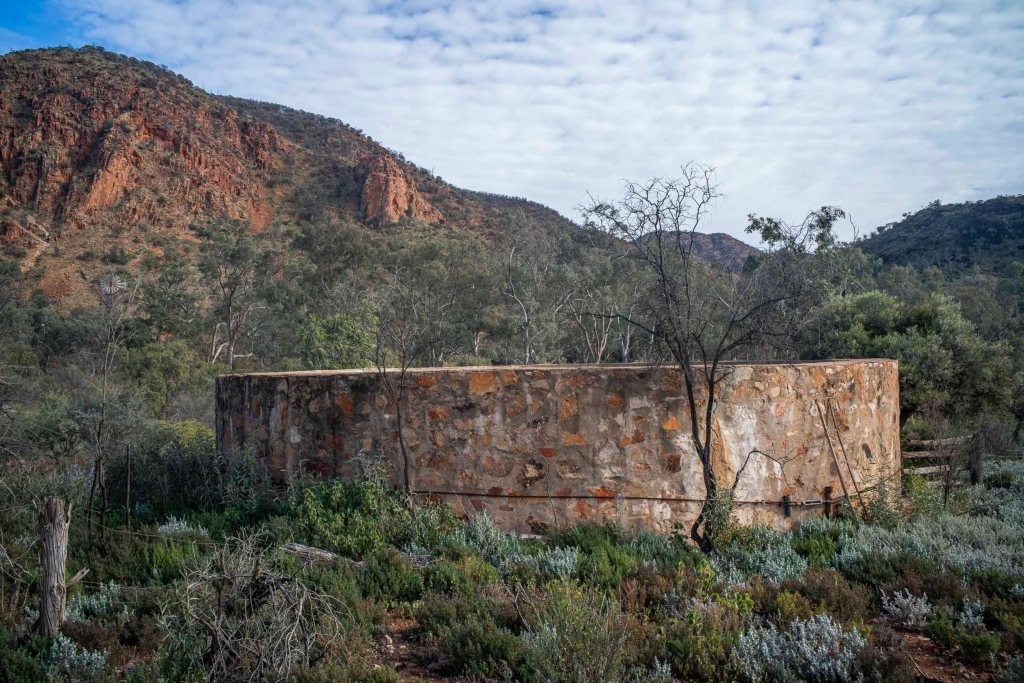
We drove the 30 or so kilometers on the Gammon Ranges Road from the Nudlamutana Hut to the Italowie Gap campsite going past Balcanoona Station and the nearby Echo cliffs.
I spent a bit of time wandering around the Gap taking photos of the traces of pastoralism before we started our walk to the gorge around 10am. The plan was to reach to Italowie Gorge around lunch time, then make our way back to the campsite where we had parked the car.

The trail along the dry creek bed was well marked with several yellow geological markers with useful information.
On the way along the creekbed one referring to the Bolla Bollana tillite-– sedimentary rocks with pebbles buried in the rocks — that was 700 million years old . The tillite in the Balcanoona Range was from the Sturtian glaciation period (mid Cryogenian), which was a world wide glaciation and part of “Snowball Earth” . This was contemporary with the dislocation of the Rodinia supercontinent.

The Sturtian glaciation represents the most extreme climate events in Earth’s history and lasted a minimum of five million years. Apparently existing geologic evidence suggests that Earth had a stable, warm, and ice-free climate before the Sturtian global glaciation. So what caused the glaciation? Volcanic activity?
At 650 million years, the geological successions record warmer interglacial conditions with an ancient barrier reef forming; outcropping rocks located in the Arkaroola Protection Area and Vulkathunha-Gammon Ranges National Park, represent one of the oldest such reefs in the world.
 The Long Road to the North
Leave a comment