
Balcannona Creek is a good example of the steep gorges, spectacular cliffs and the faulted and folded sedimentary rock in the Vulkathunha-Gammon Ranges National Park. There was no surface water in the creekbed in this part of the creek, even though it had, by all accounts, been a wet year.

The aim of the photo session was to construct geological images in the sense of the material or sensuous presentation of meaning. The image is a sensuous form that bears meaning — it is less a subjective impression (inner perception, or mental idea) than the objective presence of a picture. An image as picture that exerts a hold that lives beyond its medium presupposes an agent who is engaged by it, i.e., who finds it meaningful or significant.
Constructing geological images meant a shift away from myth in aboriginal thinking. In myth natural forms and forces are given a human face (eg., Greek mythology) or an animal form (the Rainbow Serpent) so that they become approachable for human beings. In Adnyamathanha mythology for instance the elders tell the story of Arkuru, the huge rainbow serpent, who traveled into the gorges, forming the mountains and permanent waterholes.
Constructing geological images also implies a shift away from the dualistic concept of the image in Christianity which splits the image between image and icon. It frames the image as the ‘absent’, ‘invisible’ or ‘substantial’ term that is rendered ‘present’, ‘visible’ or ‘material’ in an icon. In Christology the image is located in the ternary structure of the doctrine of incarnation. God is incarnated in the imago dei of the son who, in turn, stands behind iconic representations.
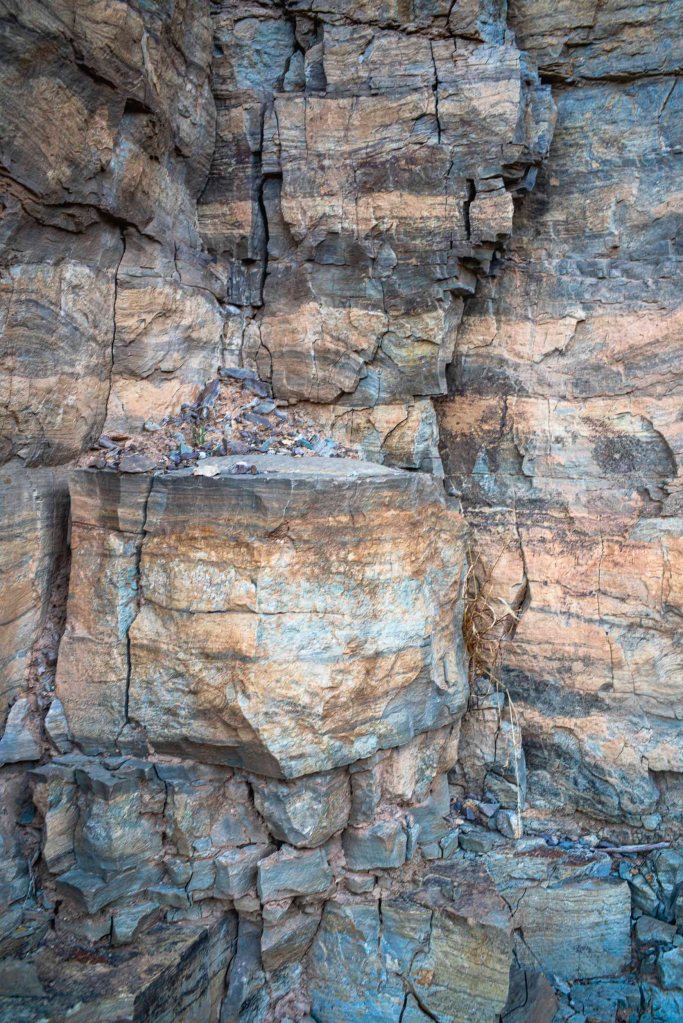
The image as a sensuous presentation of meaning is a specific type of organised form that can be distinquished from the bare materiality of the photo since it carries meaning. Consequently, the image communicates more than its perceptible features, is transferable between contexts that are different to its original one and can take on added layers of meaning through multiple layers of interpretation that operate on different levels or tracks since interpretation is subject to historical determination.
This gives rise to competing ‘sets of narratives’ which are open to contestation.
 The Long Road to the North
Leave a comment